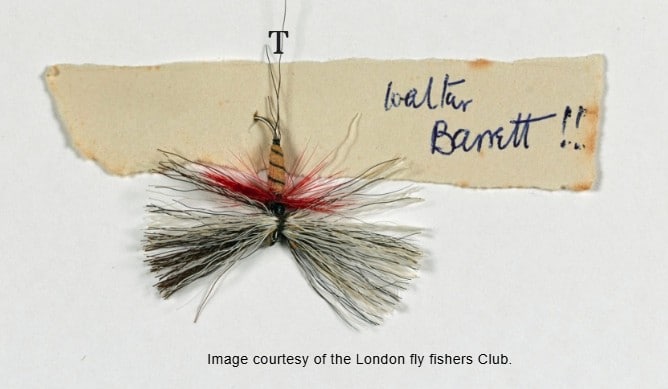
The world-famous ‘Shaving Brush’ is a mayfly spinner pattern devised on the Barton Court beat by Walter Barrett, a good friend of William Lawson, who owned the Manor house at that time. The forerunner of the Grey Wulff by a decade, it is, without question, the most iconic fly pattern in the Kennet Valley.
The story goes that one June day in 1918, Barrett noticed ”the contemptuous approach of the Kennet trout at Kintbury to the patterns of May-fly patterns I had hitherto used with success”. Flies such as Ward’s Grey, Rolt’s Red, Horace Brown’s Fore and After, and Hardy’s Variant – all “brushed aside with an indifferent tail”. Something that resembled a Kintbury trout’s natural food more accurately was required.
To imitate the outline and delicate veining of the flat, transparent wings of the spinner, Barrett used soft Badger hair, splayed out. For the opaque, off-white, but dark-ringed body, he chose Kapok cotton. As legs, he wound on a small black cock hackle on the shoulder and three very long and thin hairs astern.
One evening, seeing the red light produced by the last rays of the sun setting in the West, Barrett observed that the wings of dying gnats caught a ‘bright spot of light’. Barrett went on to replace the customary black cock shoulder hackle with one dyed scarlet on many of his ‘Shaving Brushes’.
It was such a fly that was responsible for hooking the then-record for the Barton Court water, a Kennet native weighing 5 lbs 11 oz, hooked in Shermans, a few yards above the railway bridge.
Tie your own:
- – Vice a #8-10 Kamasan B830 Mayfly hook
- – Wind black thread behind eye
- – Select a small bunch of the softest badger hair from a pelt for wings. When pointing over hook eye, these should be the same length as the hook. Secure
- – With figure-of-8 tying, separate the wings so they lie ‘spent’
- – Behind this, tie in a black or scarlet cock hackle
- – Wind thread to bend tying in three black badger hairs and length of thin black floss
- – For the body, dub thread with cream Kapok. Wind to wings. Secure
- – Rib body with 3 turns of black floss. Behind wings, secure
- – Wind 4 turns of either cock hackle colour over wing roots, Secure
- – Lift wings. Whip finish. Varnish
Keepers tip:
Although your grey wulff and French partridge will catch you plenty of fish during the mayfly hatch after a few weeks, the trout do start to wise up to the regularity of these flies floating over their heads. The shaving brush is a somewhat forgotten pattern, and isn’t it a great thought to know you’re drifting that fly over runs exactly as Walter Barrett.
If you would like to find out more about Walter Barrett’s time at Barton Court, keep an eye out for a copy of his book “ A Fisherman’s Methods and Memories” 1953.
Many thanks go to the Flyfishers’ Club, who have kindly permitted us to use images of Barrett’s shaving brush from their collection; all copyrights are held by them of both images.