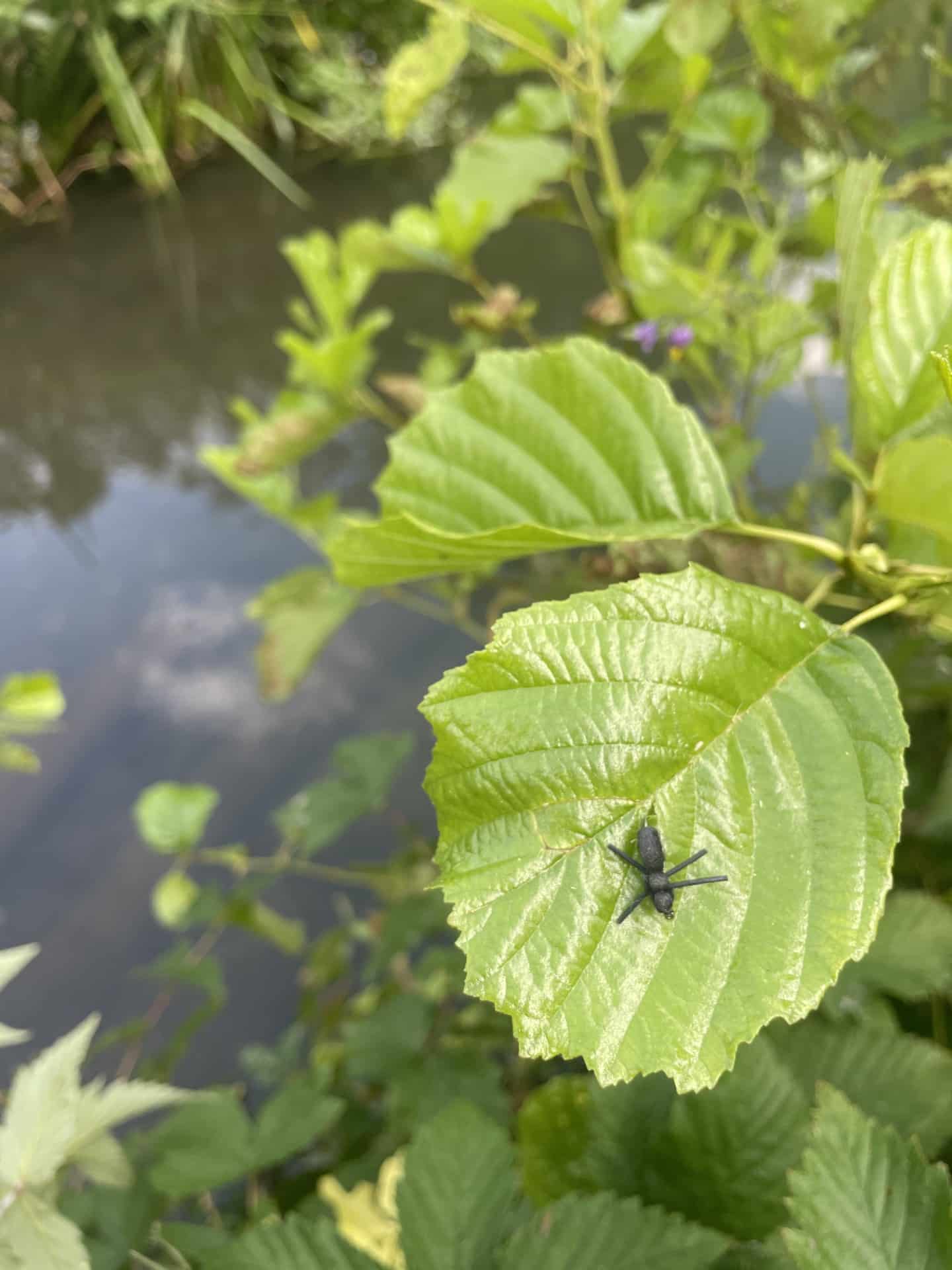
Sorry to bug you – but here’s a fly you should have crawling around in your fly box this July. Like the Hawthorne that was so effective in April, the beetle is terrestrial, too. With an imitation that’s equally successful.
They say beetles must be God’s favourite creatures. Why else should there be more different species of them than any other creature on earth? There are some 35,000 of them worldwide. But no need to get too entomological here. All you need to know is, like chocolates, they come in all shapes and sizes. And like chocolates, they sweeten the gums of the sourest-mouthed mid-summer trout lying in the shade, huddled close to the bank – waiting. Waiting for something to drop off that bush, or overhanging sedge stalk – to suck in. And a beetle might just be that something.
Colour? Black can’t fail. Size? Not too big. #14 is about right. You don’t want to give a trout too many elements in the tying to find fault with.
Mr. Lennon wears a foam jacket and has Sili legs. He’s light enough to sit half-in, half-out of the surface. But weighty enough so when he hits the stage, every trout in the audience knows he’s arrived.
Screaming fans? No. Screaming reels, yeah, yeah, yeah!
Tie your own
- Vice a de-barbed #14 Tiemco TM100 hook
- Tie black thread behind the eye. Wind to bend, tying in a thin strip of black closed-cell foam to act as the shell back
- Wind thread dubbed with a black polypropylene dubbing to halfway up the hook. Fold the foam over this. Secure
- Tie in two small lengths of black Sili Legs so they lie flat on top of the hook shank
- Wind dubbing through these legs so they sit comfortably in a criss-cross position. Fold the foam over this
- Dub remaining area up to the eye. Fold the foam over this
- Whip-finish. Varnish
- Trim legs so that they are shorter than the body.
Keeper’s Tip:
Beetles have always worked well here at Barton Court, particularly anywhere there are alder trees along the riverbank. This year has seen a good return of alder beetles in the trees, and they have already been stripping the trees of their leaves. Couple this with the winds that are normally present on the water meadows, and it’s a match made in heaven.